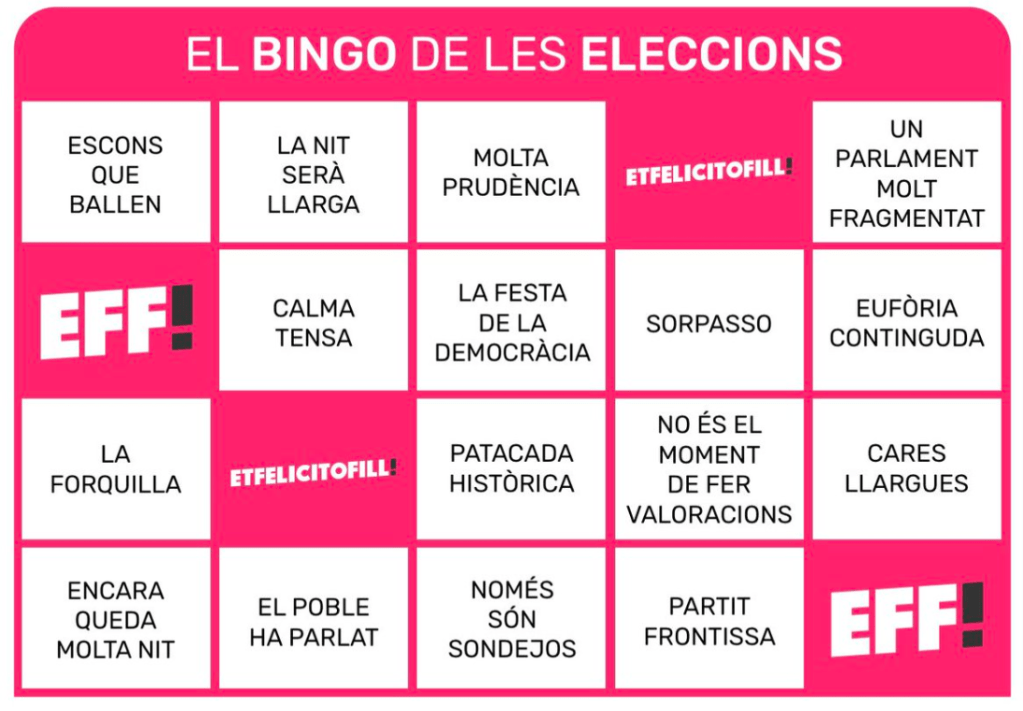
There are so many elections taking place in 2024 that it seems the party of democracy is dragging into one endless rave. As exhausting as such parties may be at times, I find a perverse sort of fun in the translation challenges of tired expressions such as “fiesta de la democracia” and other clichés popular in the media and among politicians. Here are some examples:
autocrítica: Losing candidates or parties are rarely asked to engage in “self-criticism” in English; rather, they’re encouraged to do some “soul-searching.”
- «Juan Lobato ha pedido hacer “autocrítica” tras los resultados en las elecciones gallegas» > “Juan Lobato calls for ‘soul-searching’ in light of the Galician election results.”
- Cf. “Democratic Party begins soul-searching as officials say they’re ‘furious’ with nationwide results.”
In some contexts, “take responsibility” is also an option:
- «Podemos evita hacer autocrítica tras el mal resultado en Galicia: “Teníamos una situación muy complicada”» > “Podemos avoids taking responsibility following its poor showing in Galicia: ‘We were up against a very difficult situation.’”
bailar: In the run-up to elections and on election night, certain seats are said to be “dancing,” meaning that they’re “up in the air,” “a toss-up,” or “going back and forth.”
- «En Gipuzkoa, el último escaño baila entre EH Bildu y PSE» > “In Gipuzkoa, the final seat is up in the air between EH Bildu and the PSE.”
- «Un frec a frec disputat causa un ball d’escons a Barcelona» > “Neck-and-neck race, with toss-up seats in Barcelona”
- Cf. “The fourth seat remains up in the air between Nathan “Nate” Wilson and Meghna Bansal, both of whom were at 10%.”
The concept is in some ways similar to that of “swing states” or “battleground states” in the US, but applying the expression here might be misleading because it suggests that a large number of voters can’t decide between the two parties, whereas the parties a seat is “dancing” between aren’t necessarily competing for the same voters; the phenomenon simply has to do with with the threshholds parties need to cross in order to secure representation in different constituencies.
carta a los Reyes: I explain in detail here.
cafetero: Refers to positions or politicians perceived as what we might call “hardcore,” “hardline,” or “diehard.”
- «La estrategia del “y tú más” retumbó esta semana en el Congreso entre aplausos fervorosos de los más cafeteros» > “‘Whataboutism’ as a strategy was on full display in Congress this week, and was met with fervent applause from hardliners.”
- «Sanz… ocupará el puesto que deja Elías Bendodo. Es un hombre muy cafetero, muy del PP, y había estado hasta ahora en la sala de máquinas del Gobierno anterior como viceconsejero de Presidencia». > “Sanz… will take Elías Bendodo’s place. A diehard PP man, he was a high-ranking member of the previous administration as vice-minister of the regional president’s office.”
- Cf. “Johnson took over as speaker after Rep. Kevin McCarthy was ousted in an effort led by a small faction of Republican hardliners.”
The word can also describe people who are highly interested in/knowledgable about a particular topic. There are different collocations depending on the topic in question: “political junkies,” “film buffs,” etc.
cara a cara: “One-on-one” is more natural than “face-to-face” when referring to a debate between two candidates.
cambio de cromos: This kind of political transaction in which Party A supports Party B in one area in exchange for support in another area could be rendered in in English as a “backscratching deal/agreement.”
- «Arnaldo Otegi ha asegurado que el acuerdo con el PSN para que Joseba Asirón sea alcalde de Pamplona “no es un cambio de cromos” por el apoyo de su partido a la investidura de Pedro Sánchez». > “Arnaldo Otegi says that the agreement with the PSN to make Joseba Asirón the mayor of Pamplona is not a backscratching deal in exchange for his party’s support in Pedro Sánchez’s investiture debate.”
- Cf. “Throughout the debates, Porter pressed her crusade against ‘earmarks’ — the congressional ‘back scratching’ practice of steering money toward local pet projects, perhaps in trade for a key vote.”
The expression can also refer to a “cosmetic change/shuffle/shake-up” that does not address deeper issues.
de cara a la parroquia: This expression refers to proposals or statements that are made to appeal to the group of voters most likely to support a candidate or party to begin with, a phenomenon known in English as “pandering/playing to the base.”
frec a frec: Coincidentally, the English equivalent rhymes with the Catalan: “neck and neck.” When used as a noun, it may be necessary to add “race,” as in the example given in the entry for “bailar.”
- «Final de campanya a les eleccions basques amb el PNB i EH Bildu frec a frec» > “The Basque election campaign comes to a close with the PNV and EH Bildu neck and neck”
hemeroteca: The dictionary translation of “newspaper archive” is almost laughably quaint when considering how the word is actually used colloquially. A politician’s “hemeroteca” covers everything they have said in the past (which could be translated as their “record” or simply their “past comments”) and is usually brought up when they are perceived as acting in a way that contradicts their former stance. As such, “La hemeroteca no perdona,” “La hemeroteca es muy traicionera,” “Maldita hemeroteca,” and similar expressions can be translated using the expression “come back to bite/haunt”:
- «La hemeroteca vuelve a condenar al primer edil madrileño en el marco de la mascletà de Madrid Río». > “The mayor of Madrid’s words once again come back to bite him in relation to the Madrid Río mascletà.”
pantalla passada: A video game metaphor that refers to something that’s already been tried and isn’t worth going back to, this expression can be translated as “been there, done that” or recast in a way that uses the phrase “moving on.”
- «La portaveu del govern, Patrícia Plaja, ha dit avui que “l’estatut és una pantalla passada que aquest govern no contempla en cap cas”». “Government spokesperson Partícia Plaja said today that ‘the Statue of Autonomy is been there, done that, and it’s not on the table for this administration under any circumstances.’”
pescar en el caladero: This expression could be translated as “woo over” or “court,” as it often refers to securing the support of undecided voters or trying to tap into an electorate that traditionally votes for another party.
- «“La dirección nacional del PP está convencida de que en las elecciones vascas del 2024 pueden pescar en el caladero de votos del PNV» > “The PP’s top brass is convinced that it’ll be able to woo over PNV voters in the 2024 Basque Country elections.”
- «Tindrà, però, l’encàrrec de mirar de pescar al calador socialista…» > “However, he’ll be tasked with trying to court Socialist voters…”
- Cf. “Mayor of London Sadiq Khan has launched a campaign to woo over Liberal Democrat and Green voters as he seeks a third term in office.” “Bernie Sanders: Democrats should not court far-right ‘racist, sexist’ voters.”
projecte: Talking about a candidate’s “project” for their country is one of those things that sounds ever so slightly off in English. It’s easy to fall for the cognate because after all, politicians do talk about their “projects,” plural. But these are specific initiatives. With some exceptions, such as the terrifying Project 2025, “project” isn’t generally used to refer to a large-scale set of policies or approach to governance; in such contexts it’s usually more natural to talk about an “agenda,” “program,” “plan,” “model,” or “vision” in English.
- «Retraient-li a Salvador Illa que no té cap “carai de projecte per Catalunya”, ha assegurat que el seu partit no serà “crossa d’un projecte que no es dirigeix a incrementar la justícia social”. “No podem assumir un projecte que no té cap mena de visió de futur per a la ciutadania d’aquest país”». > “Accusing Salvador Illa of having ‘no plan whatsoever for Catalonia,’ she insisted that her party would not ‘prop up an agenda that’s not focused on furthering social justice.’ ‘We can’t accept a program that completely lacks a forward-looking vision for the people of this country.’” (I translated “projecte” in three different ways in this quote to show the different options; in an actual translation the repetition of the original should probably be maintained, and I think “agenda” would be the best solution in all three cases.)
- Cf. “And it confirms what we have long suspected: Republicans don’t lack an agenda; they’re just shy about revealing how unpopular it is.” “Biden’s campaign expressed confidence that the president’s agenda would stack up well against Republicans in next year’s election.”
In some contexts, “projecte” is also used more or less as a synonym for “party”:
- «Això va provocar que projectes com Unió Mallorquina i el PI (Proposta per les Illes) sortissin debilitats». > “That weakened parties such as Unió Mallorquina and PI (Proposta per les Illes).”
propaganda: As an American English speaker, hearing “propaganda” mentioned matter-of-factly in Catalan and Spanish is a bit like hearing British English speakers talking about “schemes.” It can be hard to set aside the negative connotations and recognize that the term is used neutrally in certain contexts. Specifically, “propaganda electoral” usually has no value judgment attached and is simply “election advertising,” whether in the form of TV commercials/adverts (note: “spots” is a pseudo-anglicism), posters, leaflets, or what have you.
relat: The obvious translation of “narrative” works perfectly well in most cases, but since the narrative in question is rarely neutral or objective, in some contexts “spin” is also an option.
- «I és que avui el més important serà el relat polític perquè per als actors del pacte, més enllà del contingut, el més rellevant és com queden davant de l’opinió pública. Si han guanyat o han perdut». > “Now what matters most will be how the architects of the deal spin it, because for them, it’s less about the content and more about they’ll be perceived by the public: as winners or losers.”
sigles: As this word is used to refer to the identity of a party whether or not that party is known by any particular initialism or acronym, it’s often more accurately translated as “(party) brand/label.”
- «Com ja és habitual en la campanya del PP a Badalona Albiol amaga les sigles del seu partit» > “As is now typical of the PP’s campaigns in Badalona, Albiol is shying away from the party brand.”
- Cf. “Trump advisers say the short shrift he’s giving the Republican label reflects a view that he is the leader of a movement that is broader than one party.”
When the word is referring to the image of the initials, “logo” is a better option. A poster that is “hiding the initials” is one where “the party logo is barely visible.”
This list only scratches the surface of political clichés, but I’ll keep working on it with the goal of eventually getting translation bingo on the card below. Maybe I’m a party person after all.